The Cultural Challenge by Yannis Andricopoulos
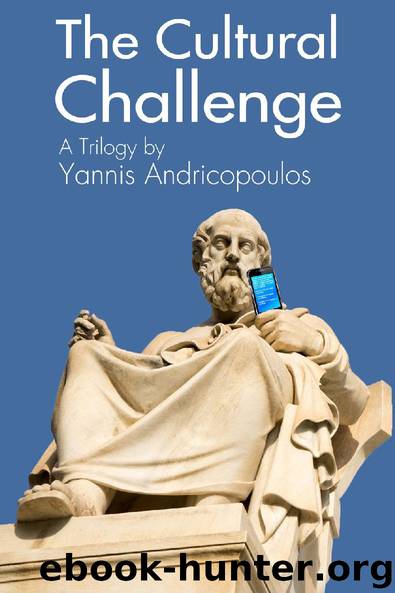
Author:Yannis Andricopoulos
Language: eng
Format: epub
Tags: Universalism, ethics, culture, classical Greece, ancient Greece, justice, values, morality, happiness, honour, society, joy, theocracy, materialism, consumerism, authoritarianism, religious extremism, civic virtue, politics, civilization, greed, fundamentalism
ISBN: 9781845409623
Publisher: Andrews UK Limited 2017
Published: 2017-11-14T00:00:00+00:00
14. A High-Trust Society
The polis, H.D.F. Kitto, the British classicist, says in his delightful book The Greeks, enriched life to an extent that no social entity had done before or has done ever since. Its ‘high-trust’ society, a term used by author Francis Fukuyama, was founded on the expectation of regular, honest and cooperative behaviour, expressing commonly shared norms, and the city’s unifying civic values, which, like the ritualised festivities, defined the community as a whole. This whole, rationalised, democratised and civilised, enhanced life and made possible the attainment of each citizen’s wellbeing. The Romantics’ mythical ‘whole’, which found expression in national socialism, was antipodal to the Greek classical whole.
The case for Athens, the city that God ‘loved best’ according to Holderlin, ‘the school of Hellas’, was made superbly by Pericles in Epitaphios, his celebrated funeral oration. The Athenians, he stated without resort to any -isms, saw in wealth an opportunity for action, not a reason for boasting, considered idleness, not poverty, disgraceful, and regarded political discussion, not a hindrance to action, but its prerequisite. They were generous, not out of expediency, but from confidence, they knew the beauty of Justice, the dangers of ambition, the folly of violence. They ran their affairs relying not upon management or trickery, but upon their hearts and hands, loved the arts without lavish display, and things of the mind without becoming soft. Justice for all alike was secured by the law, but the claim of excellence was also recognised; citizens were chosen for public service, not as a matter of privilege, but as a reward for merit. ‘Class considerations’, he emphasised, ‘are not allowed to interfere with merit’.
This speech, sections of which were being displayed on buses in England during World War I, will, incidentally, always be a source of embarrassment for me. We studied it as teenagers at school and the memory of it has me still in her arms for the wrong reasons. It never meant a thing either to me or to any other kid. All we could recall is the good laugh we had reciting his Filokaloumen gar met’ euteleias kai philosophoumen anev malakias (we love beauty in simplicity and reflect without emolliating ourselves). The joke is in the word malakia which in modern Greek means masturbation - in ancient Greek it means softening up; not effemination, as some feminists claim.
Pericles’ speech, the cultural epitome of a gentleman’s approach to politics, would seem to give an idealised picture of the ‘Republic of the Spirit’. Aware of it, Pericles himself said that a stranger, hearing ‘anything above his station’, would, indeed, suspect exaggeration. His speech did, however, describe an organic community that had at last come into its truth. The question, Raymond Williams, the English Marxist theoretician and novelist, once said, is not how we are governed, but how we govern ourselves. The Greeks had an answer to it since Solon’s days: in the freedom to be responsible for ourselves and for our actions which is, nevertheless, the freedom which for a long time now we seem not to want.
Download
This site does not store any files on its server. We only index and link to content provided by other sites. Please contact the content providers to delete copyright contents if any and email us, we'll remove relevant links or contents immediately.
| Anthropology | Archaeology |
| Philosophy | Politics & Government |
| Social Sciences | Sociology |
| Women's Studies |
The remains of the day by Kazuo Ishiguro(8943)
Tools of Titans by Timothy Ferriss(8345)
Giovanni's Room by James Baldwin(7293)
The Black Swan by Nassim Nicholas Taleb(7085)
Inner Engineering: A Yogi's Guide to Joy by Sadhguru(6775)
The Way of Zen by Alan W. Watts(6574)
Asking the Right Questions: A Guide to Critical Thinking by M. Neil Browne & Stuart M. Keeley(5734)
The Power of Now: A Guide to Spiritual Enlightenment by Eckhart Tolle(5718)
The Six Wives Of Henry VIII (WOMEN IN HISTORY) by Fraser Antonia(5482)
Astrophysics for People in a Hurry by Neil DeGrasse Tyson(5168)
Housekeeping by Marilynne Robinson(4418)
12 Rules for Life by Jordan B. Peterson(4291)
Double Down (Diary of a Wimpy Kid Book 11) by Jeff Kinney(4252)
The Ethical Slut by Janet W. Hardy(4232)
Skin in the Game by Nassim Nicholas Taleb(4223)
Ikigai by Héctor García & Francesc Miralles(4212)
The Art of Happiness by The Dalai Lama(4114)
Skin in the Game: Hidden Asymmetries in Daily Life by Nassim Nicholas Taleb(3972)
Walking by Henry David Thoreau(3937)
